

Can You Re-Roof Without Scaffolding in the UK?
Short answer: almost never, legally. For any roof work above 4 metres on a domestic property, edge protection is a legal requirement — and scaffolding is the standard way to provide it.
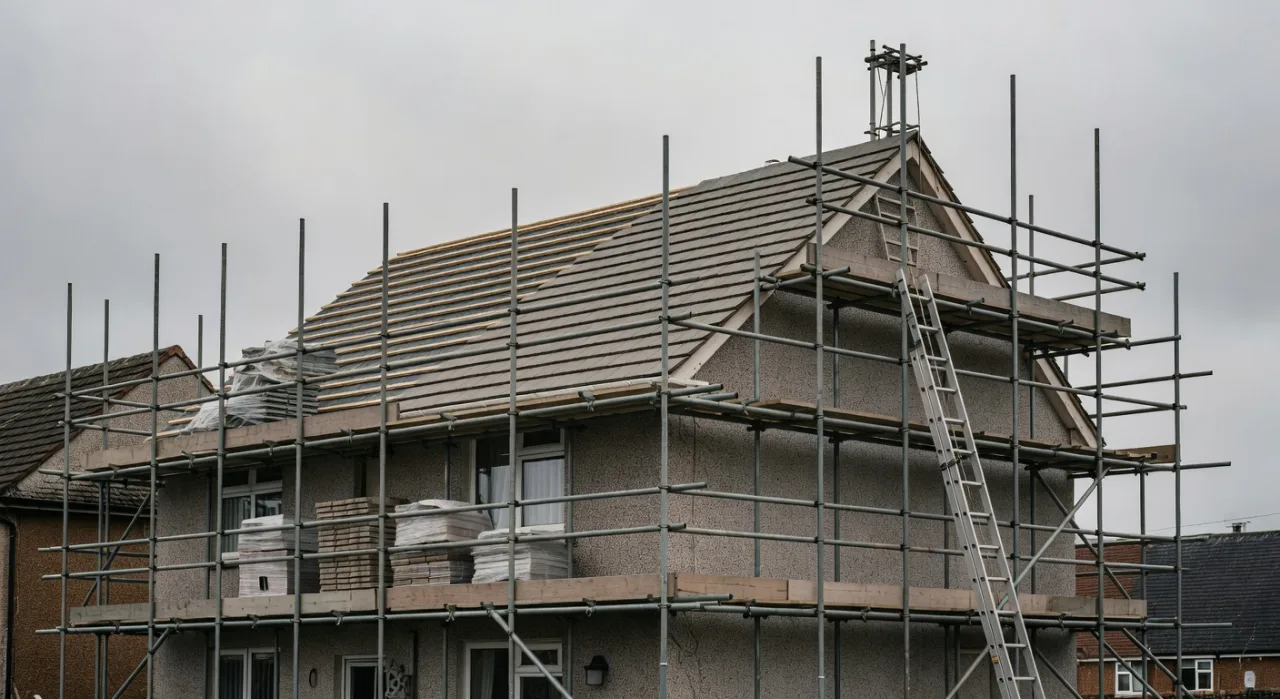
Every now and then, a homeowner asks whether a roofer can “just use ladders” for a re-roof — usually because they’ve seen cheaper quotes that skip the scaffold. The honest answer is almost never, and not legally on anything above a bungalow. Here’s what the rules actually say and what the practical alternatives are.
The legal position
The Work at Height Regulations 2005 cover any work where a person could fall a distance liable to cause injury. The regulations are explicit — Regulation 6(3):
Where work is carried out at height, the employer shall take suitable and sufficient measures to prevent, so far as is reasonably practicable, any person falling a distance liable to cause personal injury.
In practice, for domestic re-roofs:
- Any work above 2 metres where a fall could injure someone requires risk-assessed fall protection
- Any work at eaves height on a two-storey house (5m+) effectively mandates edge protection — which in turn almost always means scaffolding
- Roof ladders alone are not sufficient for re-roofing a whole roof because they don’t provide working platform or edge protection
The regulations don’t name scaffolding as mandatory. What they require is fall protection, and scaffolding is by far the most practical way to provide it on a roof job.
When ladders genuinely are enough
There are specific, narrow cases where ladder-based access is compliant:
Short-duration work, low height
A single ridge tile being replaced on a single-storey extension at 2.5m, taking 30 minutes, with the worker holding on with one hand while the other does the fix — this can be done from a properly-secured ladder.
The test is from Reg 7: “use a ladder only where the use of other more suitable work equipment is not justified because of the low risk and short duration of use or unalterable features of the work site”.
Inspection, not repair
Surveying a roof with a ladder, binoculars, and a camera — no work, no materials, no time on the ladder in one position — is usually fine.
Scaffold tower + roof ladder for small jobs
For a job like a single chimney flaunching repair on a two-storey house, a mobile aluminium tower (at eaves) with a roof ladder up to the chimney can be compliant for a short, single-trade visit. It’s not a re-roof solution.
When ladders are never enough
Full re-roofing
Stripping and relaying a roof takes days, involves moving around the whole roof, and requires materials on a working platform. Ladders alone don’t meet the Work at Height Regulations for any of those phases.
Re-roofs on two-storey or taller properties
Eaves height is 5m+. Working from ladders at that height to strip tiles and carry battens is a clear breach of the regulations, even for short tasks.
Chimney rebuild, repointing, or flashing
Chimney work is multi-day, involves tools, materials, and water/mortar. Needs a dedicated chimney lift on a scaffold — not a ladder.
Any roof work by a subcontractor on a CDM 2015 job
Under the Construction (Design and Management) Regulations 2015, principal contractors have specific duties around fall protection on construction sites. A “ladder and hope” approach would fail those duties and invalidate their insurance.
Alternatives to traditional scaffolding
If scaffolding genuinely isn’t practical, there are alternatives — though for most re-roofs, they’re not suitable.
Mobile elevating work platforms (MEWPs / cherry pickers)
A boom lift or cherry picker can provide a safe platform at roof level. Useful for:
- Single-point access (e.g. a single dormer fix)
- Short-duration work
- Sites where scaffolding is impractical (e.g. tight urban courtyards)
Not usually suitable for full re-roofs because:
- Hire costs are typically £150–£350 per day for domestic-sized units
- Can’t carry and store materials (tiles, battens) the way a scaffold can
- Needs firm, level ground — not always available in gardens or on pavements
- Only gives you one access point, not continuous platform around the roof
Roof ladders
A purpose-made roof ladder hooked over the ridge spreads load and provides a stable position for short work on the roof slope. Useful as a supplement to scaffold (for working on the roof surface itself), not as a replacement for it.
Fall-arrest systems (harnesses and anchors)
Worker wears a harness attached to a permanent or temporary anchor. Arrests a fall rather than preventing it. Generally used:
- In combination with edge protection, not instead of it
- For specific short tasks where edge protection would be disproportionate
- By roofers moving across an otherwise-protected working area
Harness-only access without edge protection would usually fail a risk assessment on a domestic re-roof.
Aluminium mobile towers
Mobile access towers (Youngman, Snappy, Bigtop) are acceptable for short-duration single-location work, and are often used for soffit / gutter / chimney repairs on two-storey houses. Limitations:
- Footprint is fixed — you can’t move the tower around a whole roof easily
- Height limits (typically to 8m for domestic towers)
- Need firm, level ground
- Have to be properly braced, with outriggers, and erected by a competent person
For a chimney repointing, a tower might be fine. For a full re-roof, no.
Why “no scaffold” quotes are cheaper — and what you’re actually buying
A roofer who says “we don’t need scaffold” is pricing for:
- Less overhead — no scaffolder, no erection day, no hire period
- Less insurance — the risk is being externalised to ladders and luck
- Less compliance margin — they’re betting no HSE inspection, no neighbour complaint, no incident
If everything goes right, the job completes and you’ve saved money. If something goes wrong:
- Worker falls — HSE investigation, possible prosecution, potentially no valid PL insurance cover
- Roof damage — the roofer’s insurer can refuse the claim on “unsafe methods” grounds
- Building control issue — inspector may flag the work as executed without proper access
The saving isn’t worth it.
What we do at Stoneley
Every re-roof we scaffold for carries:
- TG20:21-compliant tube-and-fitting scaffold sized for the roof perimeter
- Eaves-level working platform with handrails extended above roof line
- Edge protection compliant with the Work at Height Regulations
- Gable-end scaffold where chimney or gable work is involved
- Chimney lift where required, on a separate lift above the main platform
- Weekly statutory inspections with signed records
- £5 million public liability throughout the hire period
We work alongside roofers across Hampshire and the South. Most professional roofers will only work off a properly-erected scaffold — it’s faster, safer, and their insurance cover works. If a roofer insists they don’t need scaffolding for a re-roof, that’s a flag about their practices.
Frequently asked questions
Can a homeowner re-roof their own bungalow without scaffolding?
Technically the Work at Height Regulations apply to “employers” and workers — not to homeowners working solely on their own home. But HSE guidance strongly recommends the same fall-prevention standards because the physics of falling are the same. Any contractor you bring in, even for a day, is covered by the regulations fully.
Isn’t a ladder cheaper than scaffolding?
For the right job, yes — a £100 ladder versus £500 of scaffold is an obvious saving. But for a re-roof, you’re trading a one-off scaffold cost for multi-day risk, slower working pace, and potentially invalid insurance. A job that takes 4 days on scaffold can take 7 days on ladders, and day-rate roofers often cost more per day than the scaffold.
Does the Work at Height Regulations apply to domestic clients?
The duty falls on the person in control of the work — usually the roofer or builder, not the homeowner. But the homeowner can be dragged into a case as a “contracting party” if the contractor they engaged was clearly breaching the regulations.
What about terraced houses with no access to the rear?
This is a real and common problem. Options include:
- Scaffolding erected at the front and oversailing through upstairs windows to access the rear via internal routes
- A crane-lifted scaffold placed into the rear garden (expensive but feasible)
- Agreement with neighbours for access through their garden (most common)
- Redesigning the work to minimise rear access needs
We survey these properly before quoting so the access solution is built into the price.
Can scaffolding be erected around conservatories without damaging them?
Yes. Techniques include:
- Bridging — scaffolding spans over the conservatory on longer tubes, taking load to the ground either side
- Crash decks — a protective platform under the main scaffold, above the conservatory, in case of tool or tile drop
- Independent scaffold — built on the far side of the conservatory and reaching up and over
All are routine. Conservatory damage isn’t an inevitable consequence of re-roofing — it’s an outcome of poor scaffold design.
Re-roof coming up? Get a fixed-price scaffold quote via our site-survey wizard or call Chris on 07925 869 437. We quote with the roof perimeter, lift count, and any access constraints correctly sized in.
Need scaffolding in Hampshire or the South?
Get a fixed-price quote within 24 hours. No obligation.