

How Scaffolding Affects Your Neighbours (and How to Stay on Good Terms)
Scaffolding on terraced or semi-detached houses almost always touches a neighbour's boundary, airspace or parking. Here's what you legally need from them, what's a courtesy, and how to handle disputes.
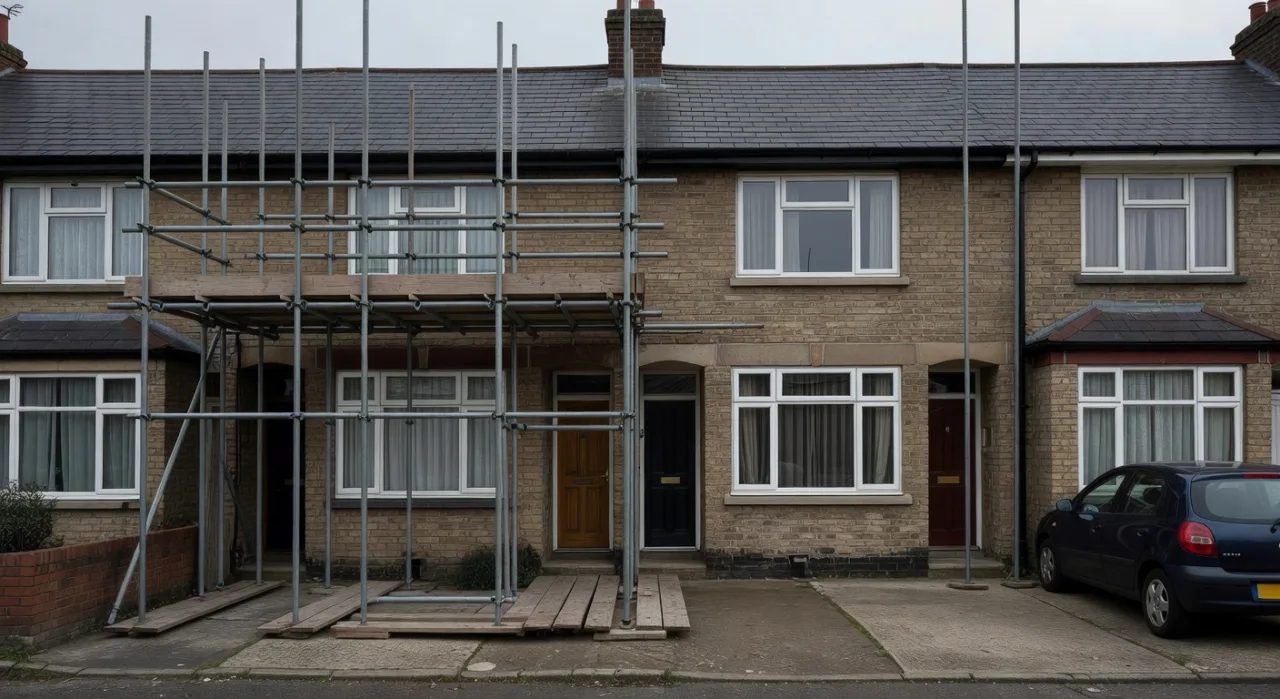
If you live in a terrace, a semi-detached house, or anywhere with a shared boundary, your scaffold will almost certainly affect your neighbour — whether that’s by standing on their land, oversailing their garden, blocking their drive, or just putting a big metal structure six feet from their bedroom window for a month.
Most of it is fine. Most neighbours are reasonable. But it helps to know what you legally need permission for, what’s just courtesy, and how to handle it if things go wrong. This guide covers the usual scenarios for UK domestic scaffolding.
When you need your neighbour’s permission
Scaffold base plates on their land
This is always a legal requirement. If any part of the scaffold’s footprint — base plates, sole boards, uprights — sits on your neighbour’s property, you need their explicit permission. Not implicit, not “they won’t mind”, not “they’re on holiday” — explicit, in writing.
Without permission, erecting a scaffold on neighbouring land is trespass. They can legally demand its removal and in some cases claim damages.
Oversailing (scaffold extends over their airspace)
The Access to Neighbouring Land Act 1992 gives you a potential right to apply to court for access when you need it to carry out basic preservation works — and only then. For most extensions, re-roofs, and renders that aren’t urgent repairs, you don’t have an automatic right.
In practice, oversailing is almost always handled by agreement, not court order. You ask, they agree, usually in exchange for you undertaking to leave their garden exactly as you found it.
Party Wall Act considerations
If the work on the scaffold is covered by the Party Wall etc. Act 1996 (e.g. work to a shared party wall, excavation within 3m of a neighbour’s foundations, some loft conversions), you must serve formal Party Wall Notice — typically 1–2 months before work starts. Most domestic re-roofs and exterior decoration don’t trigger the Act, but check with a surveyor if unsure.
When you don’t legally need permission (but should ask anyway)
Scaffold adjacent to their boundary
A scaffold entirely on your land, immediately against a shared fence or wall, is legally yours to erect. You don’t need permission.
But the scaffolders will be working metres from the neighbour’s windows for weeks. Telling them in advance — date of erection, approximate duration, any noisy phases — is the difference between “the guy next door is considerate” and “why didn’t he even tell me?”.
Loss of their view
If the scaffold blocks their view temporarily, that’s not something you need permission for — there’s no right to a view under English law. But again: a quick heads-up goes a long way.
Scaffolds on the pavement outside their house
If your scaffold extends along the pavement in front of their house, the pavement licence from the council is what authorises the scaffold being there. Your neighbour’s permission isn’t legally required. But if you’re blocking easy access to their front door or parking space, courtesy still matters — sometimes a lot.
Practical issues that cause disputes
Parking
This is the single most common scaffolding-neighbour dispute. The scaffolder’s flatbed arrives to unload, blocks the road for an hour, and now the neighbour who drives a taxi for a living can’t get out on time. Or the scaffold itself occupies the parking bay they’ve used for 15 years.
Fix: let neighbours know the erection date and approximate time at least a week in advance. Offer to move their car yourself if needed. For ongoing parking impact, ask the council whether your licence can include a temporary parking bay suspension.
Access to their side gate or drive
If your scaffold covers part of a shared passageway or alleyway, their access can be impeded. Pedestrian access should never be fully blocked — a pedestrian tunnel is required on any scaffold where pedestrians would otherwise need to walk in the road.
Fix: talk to them, time the erection to minimise peak impact, and ensure the scaffolder leaves adequate passage.
Debris and dust
Scaffold isn’t the issue — the work on the scaffold is. Dust from render, debris from re-roof, noise, paint splatter. Courtesy is to tell neighbours when the noisy phases are so they can plan around it.
Fix: ask the builder for a realistic timeline of phases. “Tues-Wed next week will be stripping old tiles — expect noise and dust. Thursday onwards is quieter.” Share it.
Damage to their fence or garden
Scaffold base plates on soft ground can sink or tilt and put pressure on fences. Materials getting swung into place can dent things. Boots in a flower bed. These are real risks.
Fix: your scaffolder should carry £5 million public liability insurance (ours does). Any damage caused by the scaffolder or people working from the scaffold is covered. Document the state of the boundary before work starts — photos with dates — and share copies with the neighbour as a courtesy.
How to approach the neighbour conversation
Before you ask, know exactly what you need:
- The dates the scaffold will be up
- Whether the scaffold touches their property (base plates on their drive, over their garden, etc.)
- Whether their access is affected (driveway, gate, pavement)
- What insurance and liability cover exists (a one-line summary is usually enough — “the scaffolder is insured to £5m, and anything that happens is covered”)
Offer:
- Written confirmation of all of the above (email is fine)
- Your scaffolder’s contact details so they can raise concerns directly
- A small gesture if the impact is significant — a bottle of wine on removal day, or offering to compensate for a specific inconvenience
Avoid:
- Starting the scaffolders’ arrival as a fait accompli — you want permission before the lorry turns up
- Framing it as “we’ve already decided” — people are more cooperative when asked
- Promising timescales you can’t keep. If the job slips, tell them as soon as you know
What to do if the neighbour refuses
For scaffold base plates on their land
You can’t proceed without permission. Options:
- Design the scaffold without using their land — usually possible with a free-standing (independent) scaffold, which is 20–30% more expensive but doesn’t require permission.
- Apply under the Access to Neighbouring Land Act 1992 — only for “basic preservation” work. Slow (court application) and usually more trouble than a re-designed scaffold.
- Negotiate — sometimes an offer to pay for a specific piece of garden maintenance or fence repair changes their answer.
For oversailing their airspace
Less clear-cut legally, but in practice you’re in the same position — unless the work is urgent preservation, you need their agreement or a redesigned scaffold.
For objections to noise / parking / inconvenience
These aren’t things they can legally prevent. Keep communication open, minimise impact, and escalate to the council only if they’re actively interfering with lawful work (e.g. moving barriers, blocking the scaffolders’ access to your property).
Ongoing courtesy during the job
- Give a 24-48 hour heads-up before erection and before dismantle
- Tell them when the noisy days are
- Keep the working area tidy — brush up at the end of each day
- Don’t let trades park across drives or leave vans in impractical spots
- When the scaffold comes down, check the boundary — any marks, any damage, any debris — and put it right before asking for sign-off
What we do at Stoneley
- Neighbour-notification template — we help you draft the heads-up note to give next door
- Base-plate positioning reviewed at survey stage so we avoid neighbour land where possible
- Proactive communication — scaffolders carry contact details for both you and the neighbour so small issues get raised directly, fast
- £5 million public liability on every job, with certificate available to neighbours on request
- Same-day response to any boundary or damage concern during the hire period
Frequently asked questions
Can my neighbour legally stop my scaffold going up?
If it’s entirely on your land and doesn’t cross their boundary, no. If any part of it is on their property or oversails their airspace, yes — they can refuse permission, and proceeding without it is trespass.
What if they agreed and then changed their mind?
Legally, they can withdraw consent. You’d need to remove the offending parts and redesign. In practice, this almost never happens on a well-managed job — most retractions come from communication failures, not genuine disagreements.
Who pays if the scaffold damages their fence?
The scaffolder’s public liability insurance. This is one of several reasons to only work with scaffolders who carry proper cover and will document the state of boundaries before starting.
Do we need a letter from the neighbour or is a verbal OK fine?
Always get it in writing — even a text message or email. It protects both sides if memories later differ on what was agreed.
What if they own the pavement in front of their house?
They don’t. Public pavements are the highway authority’s responsibility. Your scaffold licence is issued by the council, not by the neighbour — but you should still let them know.
Dealing with a scaffold that affects a shared boundary? We survey every job with neighbour impact in mind and help with the conversation where we can. Get a quote or call 07925 869 437.
Need scaffolding in Hampshire or the South?
Get a fixed-price quote within 24 hours. No obligation.