

How Much Does Scaffolding Cost in the UK? (2026 Prices Explained)
Scaffolding for a typical UK terraced house runs £450–£900 for a standard hire period. Here's how scaffolders price jobs, what changes the number, and how to compare quotes properly.
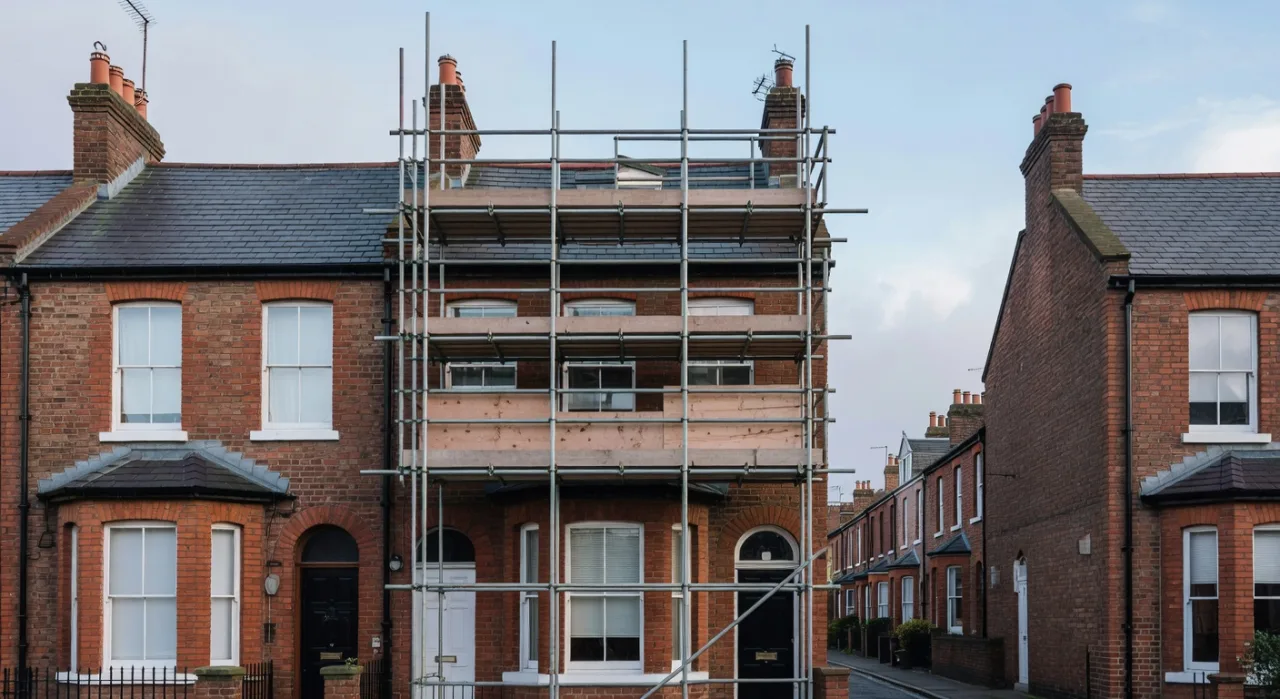
Scaffolding cost in the UK depends on four things: the perimeter of the scaffold, how many lifts it has, how long it stays up, and how hard the site is to access. For a typical two-storey terraced house having work done to the rear elevation, expect to pay somewhere between £450 and £900 for the standard hire period. A full wrap around a detached 4-bed house for re-roofing is more likely £1,200–£2,500.
This guide explains how scaffolders actually price jobs, so you can compare quotes without guessing.
How scaffolding pricing works
Scaffolding isn’t priced by the hour or by square metre of wall. It’s priced by:
- Linear metres of scaffold — the run along the wall at each level
- Number of lifts — a “lift” is one working platform. A bungalow typically needs 1 lift; a two-storey house needs 2; a three-storey needs 3, plus often a chimney lift on top
- Hire period — most scaffolders include a 6–8 week initial hire in the base price, then charge weekly after that
- Extras specific to the site — pavement licences, pedestrian tunnels, sheeting, Monarflex, loading bays, stair access, soft-ground padding, crane hire
Every scaffolder uses their own rate card, but the maths all follows that pattern.
Typical 2026 UK scaffolding prices
These are general market ranges for Hampshire and the South. The numbers aren’t fixed — they depend on the factors below — but they’re a reasonable starting point for comparing quotes.
| Job type | Typical range | Hire period included |
|---|---|---|
| Chimney scaffold (one side) | £300 – £550 | 6 weeks |
| Single gable end scaffold, two-storey | £400 – £750 | 6 weeks |
| Rear elevation, terraced house | £450 – £900 | 6–8 weeks |
| Full wrap, semi-detached (3-bed) | £850 – £1,600 | 6–8 weeks |
| Full wrap, detached (4-bed) | £1,200 – £2,500 | 6–8 weeks |
| Three-storey townhouse, full wrap | £1,800 – £3,500 | 6–8 weeks |
Weekly extension after the initial period is usually £20–£50 per week on a domestic job.
What makes a scaffold cost more
Height and number of lifts
Each additional lift adds materials, labour, and inspection time. A three-storey house doesn’t just cost 50% more than a two-storey — it can cost twice as much, because you also need heavier base plates, more bracing, and sometimes a tie into the building.
Access
A scaffold you can walk up to with a flatbed lorry and drop in 90 minutes is cheaper than one where every tube has to be carried through a side passage or craned over a garage. If your back garden is accessible only through the house, expect the quote to reflect that.
Ground conditions
Tarmac driveways, paved patios, and level lawns are fine. Soft earth, sloping gardens, timber decking, and pavement crossings need extra timbers, base plates, and sometimes spreader boards. It’s not usually a lot of money — tens of pounds rather than hundreds — but it’s a line item.
Sheeting and wrap
Monarflex sheeting (to contain debris during re-roofing or render work) adds material cost and wind-loading, which often means extra ties. Typical uplift: £150–£400 for sheeting on a domestic job.
Pavement licence
If the scaffold sits on a public pavement or road, you need a street works / scaffolding licence from the local highway authority. The scaffolder usually applies, but you pay the fee — typically £80–£300 depending on council — plus any road-closure notices.
Specialist elements
- Loading bays (for bringing materials up to the platform) — £150–£350
- Pedestrian tunnels (for pavement-mounted scaffold) — £200–£500
- Crash decks (for work over sensitive ground or conservatories) — £250–£700
- Independent scaffold (free-standing, not tied to the building) — typically adds 20–30% vs a tied scaffold
What shouldn’t change the price after you’ve accepted
A quote is a quote. Once you’ve signed it off in writing, the number shouldn’t move — unless the job itself changes (you add a chimney lift, extend the hire, or the scaffold needs altering to accommodate different trades).
If a scaffolder tells you on day one that “it’s a bit tighter than it looked, we’ll need to charge more,” that’s a red flag. A proper quote is based on a survey — either an in-person visit or aerial imagery — and should account for the site before it arrives.
How to compare scaffolding quotes fairly
Quotes vary in how much they include. Check each one for:
- Hire period included — 6 weeks or 8? This changes the headline number significantly.
- Inspections — are the statutory seven-day inspections included? (They’re a legal requirement, so if they’re not in the price, they’re an extra.)
- Pavement licence fee — is this included or separate?
- Dismantle date flexibility — what happens if your job overruns by a week?
- VAT — is the quote inclusive or plus VAT (20%)?
- Insurance — the scaffolder should carry £5 million public liability minimum. Ask for certificate copy.
Three quotes that all say “£800” can mean very different things. Ask each scaffolder to break the price down the same way and the real difference becomes obvious.
Weekly extension charges — the part people forget
If your job runs over the included hire period, you pay weekly. That’s fair — the scaffold is tying up materials that could be on another job — but the weekly rate varies wildly. We’ve seen quotes with £15/week extensions and quotes with £75/week extensions for similar-size scaffolds.
On a 4-week overrun, that’s the difference between £60 and £300. Always ask.
Pricing at Stoneley Scaffolding
We quote fixed-price in writing within 24 hours. Every domestic quote includes:
- 8-week initial hire (longer than industry standard)
- Statutory weekly inspections — carried out and signed off
- All materials — base plates, sole boards, toe boards, guardrails, Monarflex if needed
- CISRS-carded PAYE crews (not subcontracted)
- £5 million public liability insurance
- TG20:21-compliant design, SG4:22-compliant erection
Pavement licence fees are passed through at cost. Weekly extensions after 8 weeks are priced upfront and disclosed on the quote — no surprises on week 9.
Frequently asked questions
Can I get a scaffolding quote without someone visiting the property?
Yes. Our site-survey wizard uses satellite imagery and Street View so we can quote most domestic jobs from aerial data. We only visit before the price is agreed if there’s something we genuinely can’t see from overhead — like rear access constraints or ground conditions.
Is scaffolding cheaper in winter?
Usually, slightly. Demand drops between November and February (fewer re-roofs and exterior projects) and some scaffolders offer off-peak rates. That said, adverse weather can delay erection — wind over 40 mph means we stop work.
Do scaffolders accept part-payment?
Standard terms in the industry are 50% on erection, 50% on completion. Some will ask for a deposit up front on larger jobs. We invoice on erection (for the hire period) with optional weekly extensions billed at the end.
What’s the difference between “hire” and “purchase”?
You’re not buying the scaffold — you’re paying for it to be erected, stay in place for a period, and then dismantled. The scaffold belongs to the scaffolder throughout. “Hire period” = how long it stays up in the agreed price.
Want a fixed-price scaffolding quote for your property? Use our site-survey wizard — takes about three minutes — or call Chris directly on 07925 869 437.
Need scaffolding in Hampshire or the South?
Get a fixed-price quote within 24 hours. No obligation.