

How Long Does Scaffolding Stay Up? Domestic and Commercial Timelines
A standard domestic scaffold hire is 6–8 weeks. Here's how long you actually need for re-roofing, rendering, painting, and commercial jobs — plus what happens if you overrun.
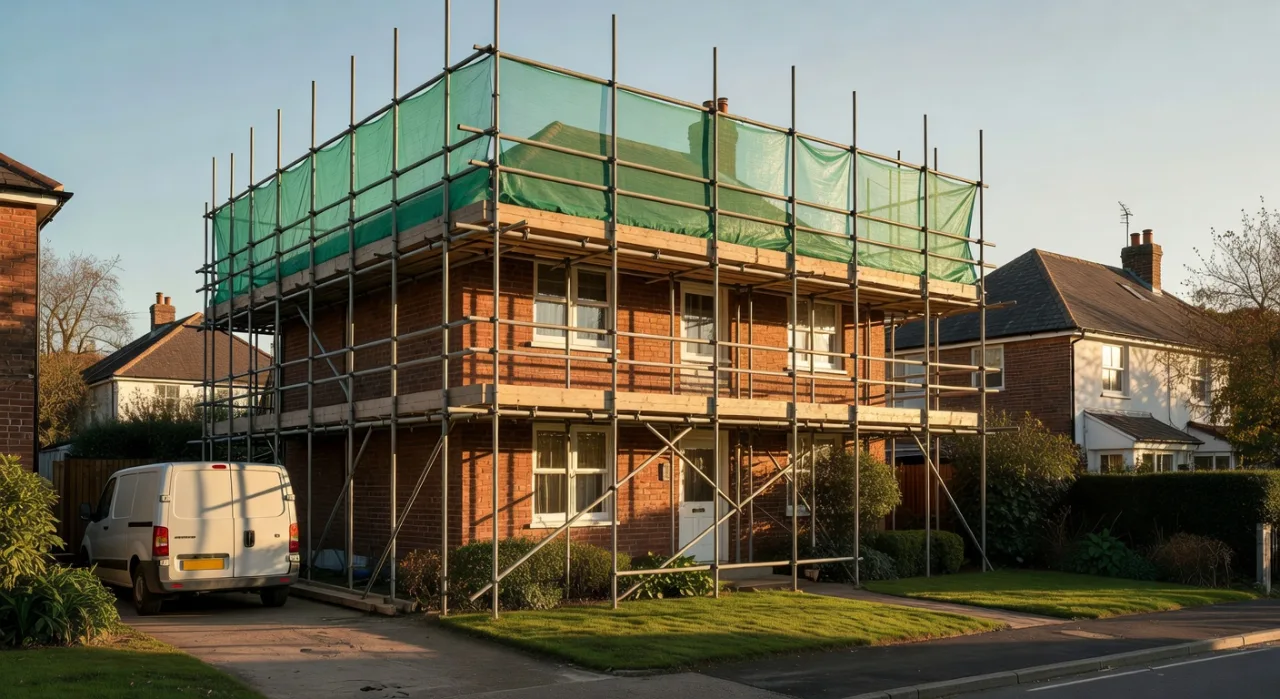
Most UK scaffolders include a 6-to-8 week hire period in their domestic quote. That covers the majority of jobs — a re-roof, a render, a chimney rebuild, or external painting can all usually be completed inside that window. But “how long the scaffold is up for” isn’t the same as “how long the scaffold is quoted for”, and the difference catches people out.
Here’s a realistic breakdown by job type.
Standard hire periods
| Work type | Typical time on scaffold | Hire period we’d quote |
|---|---|---|
| External paint, 2-bed terrace | 5–10 days | 6 weeks |
| Re-roof, semi-detached | 2–3 weeks | 6 weeks |
| Full house render | 3–5 weeks | 8 weeks |
| Chimney rebuild | 1–3 days of work | 6 weeks |
| Velux install / loft conversion (external stage) | 1–2 weeks | 6–8 weeks |
| Wall insulation retrofit | 2–4 weeks | 8 weeks |
| Commercial re-roof (large warehouse) | 4–12 weeks | Project-specific |
Notice the gap between actual working time and hire period. That’s deliberate — scaffold is scheduled in phases, weather delays happen, and trades are rarely available on back-to-back days.
Why the hire period is longer than the work
1. You’re not the only trade on the job
A re-roof is roof work plus fascia, soffit, gutter, possibly lead flashing, maybe dormer repairs, maybe chimney work. Each trade has their own schedule. The scaffold stays up until all of them are done.
2. Weather
We stop scaffold work over 40 mph winds and halt roof work in persistent rain. On a typical April–October roof job, expect 1–3 weather days across a 2-week job. That’s one reason we quote 6-week hire for 2-week work.
3. Final inspection
Building control visits, warranty inspections, or surveyor sign-offs often need the scaffold still in place. Removing it early means paying to re-erect.
4. Defects and snagging
If a roofer spots a problem on day 8, you want the scaffold still there. Pulling the scaffold on day 14 and then having to bring it back for a day 20 snag costs more than leaving it the extra week.
What happens if you overrun
Most scaffolders charge a weekly extension rate after the included hire period expires. Typical 2026 domestic extension rates are £20–£50 per week, though this varies with size and scaffolder.
Overrunning is common — not unusual — and it’s almost always cheaper to extend the hire than to dismantle and re-erect. A return visit for re-erection typically costs 40–60% of the original erection charge.
Always ask what the weekly extension rate is before you accept a quote. Two quotes at the same headline price can differ by hundreds of pounds on the weekly rate.
How long does it take to put scaffolding up?
Separate question, separate answer. Time on site to actually erect the scaffold:
| Scaffold | Typical erection time |
|---|---|
| Small chimney access | 2–3 hours |
| Single gable end scaffold, two-storey | 3–5 hours |
| Rear elevation, 2-bed terrace | 4–6 hours |
| Full wrap, semi-detached | 6–10 hours (often 1 day) |
| Full wrap, detached 4-bed | 1.5–2 days |
| Three-storey townhouse, full wrap with sheeting | 2–3 days |
Dismantle is typically half the erection time. So a scaffold that took 8 hours to put up comes down in about 4.
Commercial jobs
Commercial scaffolds are quoted by project, not by a standard hire period. Typical drivers:
- Re-roofs — 4 to 12 weeks depending on building size
- Refurbishment of listed buildings — 3 to 12 months; scaffolds stay up through multiple trade phases
- New-build facade work — usually 4 to 16 weeks
- Inspection-only scaffolds (for cladding or fire-safety surveys) — 1 to 4 weeks
On commercial work, the scaffolder typically provides a site-specific schedule with phase-by-phase dates. Weekly inspections are still statutory, and the scaffolder issues written reports after each one.
Pressure to keep scaffold up longer than booked
Sometimes another trade — usually the one that turned up late — will ask “can we keep this up another fortnight?” The answer is almost always yes, provided you (not them) agree the cost extension with the scaffolder. Two rules for this:
- Agree extensions with the scaffolder directly, not via the roofer / builder who’s on site. The scaffolder owns the materials and the liability; they need to know.
- Get extensions in writing — even a WhatsApp with the new removal date and confirmed weekly rate is fine. No verbal “yeah that’s fine we’ll sort it later”.
Pressure to remove scaffold early
The opposite also happens — a job finishes a week early and the builder wants the scaffold down so the client’s garden can go back to normal. Early removal almost never saves money unless the original quote explicitly offered it. Most scaffolders have already committed the dismantling day, and flexing that date forward isn’t always possible.
Ask upfront: “what’s the process if we finish early?” Some scaffolders will credit partial extension weeks back; many won’t. Know before you sign.
What we do at Stoneley
- 8-week initial hire included on all domestic quotes — 2 weeks longer than industry standard
- Weekly extension rate disclosed on the quote — you know week 9’s cost before you agree week 1
- Statutory seven-day inspections included — a compliance record that stays with the job
- Flexible dismantle dates — notify us 48 hours before you want it down; we’re usually available within 2 working days
- Return-visit rate — published upfront if you do need the scaffold back after removal
Frequently asked questions
Can I keep the scaffold longer for an extra fee?
Yes, that’s what weekly extensions are for. Most jobs can extend indefinitely at the agreed weekly rate, provided the materials aren’t needed on another job. Always extend rather than remove-and-return.
How long does it take to dismantle scaffolding?
Typically half the erection time. A domestic scaffold that went up in 6 hours comes down in 3. Dismantle is scheduled on a specific day and usually done in a single visit.
What happens to the scaffolding after it’s down?
Materials go back to the yard, get sorted, inspected, and redeployed on the next job. Scaffold tubes are on a 10–20 year lifecycle depending on usage; base plates and fittings are inspected before each use.
Can I work on the scaffold myself?
Only if you’re competent to do so. The scaffold is designed for specific load classes (light duty, general purpose, heavy duty) — if you’re carrying bags of cement up for rendering, that’s heavy duty and needs to be designed for it. Always ask the scaffolder what the scaffold is rated for.
How long is a scaffold inspection valid?
Seven days. Under Regulation 12 of the Work at Height Regulations 2005, every scaffold used for construction work must be inspected every seven days, and after any event that could affect stability (high winds, vehicle impact, unauthorised alteration). We do these on every job and leave a signed record.
Getting a fixed-price scaffolding quote for your job? Use our site-survey wizard or call Chris on 07925 869 437. We quote within 24 hours with the hire period clearly set out.
Need scaffolding in Hampshire or the South?
Get a fixed-price quote within 24 hours. No obligation.