

Is a Single-Lift Scaffold Enough for My Roof Job?
A single-lift scaffold gives one working platform at eaves height. It's right for most bungalow roof work, gutter replacement, and fascia jobs — but not for chimneys or two-storey re-roofs.
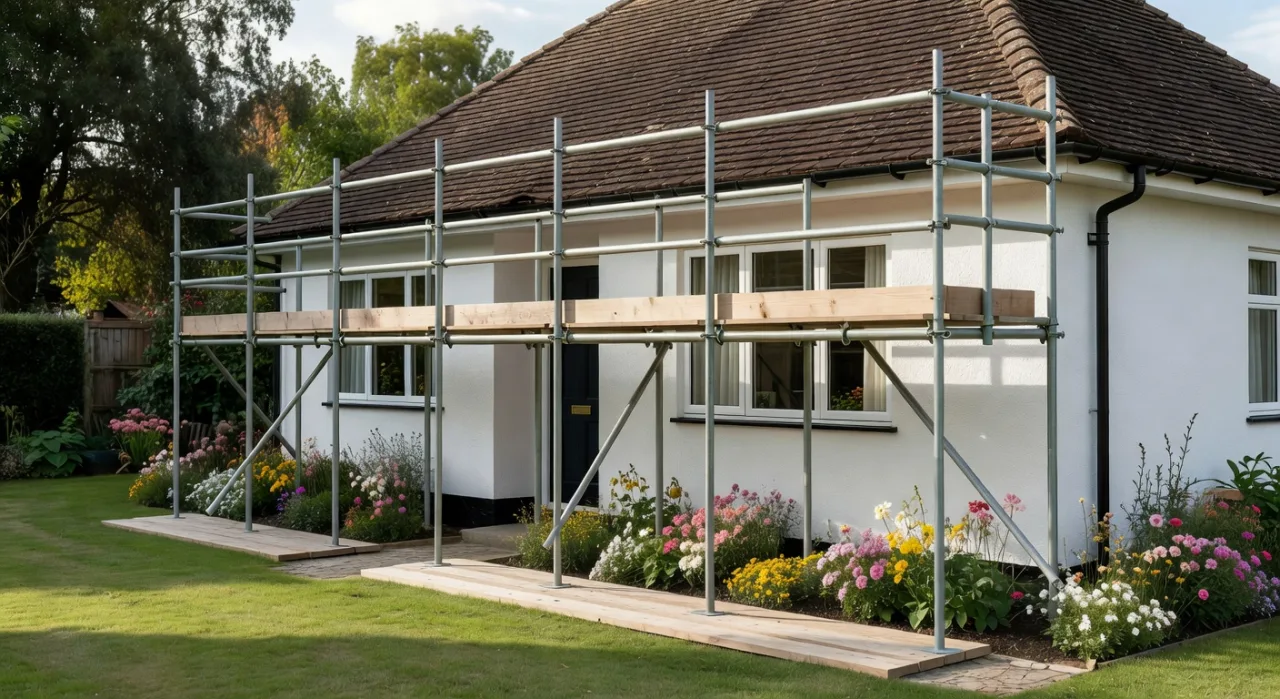
A single-lift scaffold — sometimes called a “single-lift stage” — gives you one working platform, typically at eaves height. It’s the most common scaffold on domestic bungalows and single-storey extensions, and it’s usually all you need for gutter work, fascia replacement, soffit repairs, and simple re-roofs where you don’t need to work above the ridge.
But “one lift” isn’t always enough. Here’s how to tell if your job is a single-lift job — or something larger.
What a single-lift scaffold is
Scaffold “lifts” are the horizontal working platforms stacked up the structure. One lift = one platform. Two lifts = two platforms (usually at eaves and mid-height on a two-storey). Three lifts = three platforms.
A single-lift scaffold has:
- One working platform
- Typically at eaves height (the lowest point of the roof)
- Standard platform width of 1.2m (for general-purpose domestic work)
- Toe boards, guardrails, and mid-rails on all sides
- Base plates and sole boards on the ground
It’s the simplest and cheapest scaffold configuration available — typically £300–£650 for a standard domestic hire period.
When a single lift is enough
Bungalow re-roofs
On a single-storey bungalow, the eaves are at 2.3–2.8m. Working from a platform at eaves level gives you direct access to the roof, the ridge, and the chimney (if any). One lift is usually all you need.
Gutter, fascia, and soffit replacement
The work happens at eaves height. You need a platform there, not higher. A single lift along the affected elevation does the job.
Small solar-panel installs on bungalows
PV installers need eaves access for mounting rails and for safe working above the roof plane. A single-lift scaffold gives them that on a bungalow.
Single-storey extension re-roof
A kitchen extension or garage re-roof is typically 2.2–2.5m to eaves. Single lift covers it.
External painting of bungalow walls
Two lifts of paint-work from one platform at eaves height reaches ground level via working off the scaffold, ladder, or bar-lift access.
Rainwater goods upgrades
New hoppers, downpipes, gutter guards — all at or just below eaves. One lift is correct.
When you need more than one lift
Two-storey house re-roofs
Eaves are typically at 5.0–5.5m on a standard two-storey house. Working from a single lift at eaves height is fine for roof work — but you need roof-edge protection and a handrail that extends above the roof edge. That’s a single-lift-plus-handrail extension, sometimes called an eaves scaffold.
For a full re-roof including gable-end work, you need a second lift higher up the gable. This is a two-lift scaffold.
Chimney work
Chimneys usually need their own chimney lift — a platform at or near ridge level, sometimes extending above. Re-pointing a chimney from a single lift at eaves isn’t possible on a standard two-storey house.
Velux install / rooflight fitting
Velux installs happen in the slope of the roof, somewhere between eaves and ridge. You need access from the roof surface, which means eaves-level platform plus edge protection above eaves.
Full external renders or insulation retrofit
Render work covers the whole wall, top to bottom. That’s a two-lift minimum on a two-storey house, plus additional platforms if the render extends to gable apex.
Painting the full height of a two-storey
Same as render — you need platforms at two heights minimum to work the whole elevation without awkward reach.
Loft conversions (external stage)
Loft conversion external work (new dormer windows, roof extension, skylights) needs full roof access from multiple levels.
How many lifts for my job?
Quick guide:
| Property | Typical job | Lifts needed |
|---|---|---|
| Bungalow | Re-roof | 1 |
| Bungalow | Fascia/gutter | 1 |
| Bungalow | Chimney rebuild | 1–2 (with tower) |
| Two-storey terrace | Gutter/fascia | 1 |
| Two-storey terrace | Full re-roof | 1 with eaves handrail, or 2 |
| Two-storey terrace | Chimney work | 2 + chimney lift |
| Two-storey semi | External paint | 2 |
| Two-storey semi | Full render | 2 |
| Two-storey detached | Re-roof with gable work | 2–3 |
| Three-storey townhouse | Any external work | 3 + optional ridge lift |
Single-lift cost vs multi-lift cost
A single-lift scaffold is not half the price of a two-lift scaffold. Adding a second lift roughly adds 60–80% of the first lift’s cost, not 100%. Third lifts are typically another 40–50% on top.
Rough 2026 cost guide:
| Scaffold | Typical range |
|---|---|
| Single lift, 6m run (bungalow rear) | £300 – £550 |
| Single lift, 12m run (bungalow full elevation) | £400 – £750 |
| Two-lift, 8m run (terrace rear) | £500 – £900 |
| Two-lift, 12m run (semi full elevation) | £700 – £1,400 |
| Three-lift, 12m run (townhouse) | £1,100 – £2,200 |
See our separate guide on how much scaffolding costs in the UK for the full breakdown.
What happens if you under-specify
If you order a single-lift scaffold and then realise mid-job that you actually need a chimney lift or a second level, the scaffolder can add it — but it’s usually more expensive than having quoted it correctly up front:
- Additional lift added mid-hire: typically the normal lift cost + 20–30% call-out surcharge
- Chimney lift added mid-job: £200–£500 depending on access
- Waiting time — you’re on the clock for any trade that’s been sent home because the scaffold isn’t adequate
Always describe the job accurately when you get quotes. “Re-roofing a two-storey semi” is different from “replacing gutters on a bungalow”, and the scaffolder needs to size the scaffold correctly.
What to tell us when you quote
To size the scaffold correctly, we need:
- Property type and approximate height (bungalow / two-storey / three-storey)
- Which elevations need scaffold (front / rear / gable / full wrap)
- What work is being done (re-roof / render / paint / gutter / chimney etc.)
- Whether there’s a chimney that needs access
- Any trades working from the scaffold — some need specific platform widths
Our site-survey wizard walks through these questions. Once you’ve answered, we quote fixed-price within 24 hours with the lift count correctly specified.
Frequently asked questions
Can I stand on top of a single-lift scaffold instead of using a second lift?
No. The working platform is the only place you should be working from. Climbing on guardrails, top rails, or improvising extra height isn’t permitted — it’s an SG4:22 violation and you’d fall outside the scaffolder’s insurance cover. If you need more height, add a lift.
Will one lift work for painting my two-storey house?
Only the lower half. You’d need a second lift to reach the upper storey safely. Anyone offering a single-lift scaffold for a full-height paint on a two-storey house is cutting a corner you shouldn’t accept.
How tall is a “lift”?
Typically 2 metres floor-to-floor between lifts on a domestic scaffold. The platform is a nominal 1.9m below the one above, accounting for board thickness and toe board. That’s why eaves height + chimney height often works out to exactly 2 lifts above the first.
Can I upgrade a single lift to two lifts after it’s erected?
Yes, but you pay the add-on and there’s usually a 24-48 hour lead time while crew and materials are available. Plan correctly the first time.
What’s the maximum height for a single-lift scaffold?
Around 2.7m platform height without specific engineering. Above that, you’d typically go to a two-lift scaffold rather than extending a single lift further up.
Unsure how many lifts your job needs? Tell us what you’re doing and we’ll tell you straight. Get a quote or call 07925 869 437.
Need scaffolding in Hampshire or the South?
Get a fixed-price quote within 24 hours. No obligation.