

Tube-and-Fitting vs System Scaffolding: Pros, Cons, and When Each Makes Sense
Tube-and-fitting is flexible but slower to erect. System scaffolds go up fast but cost more and don't adapt. Here's which belongs on your job.
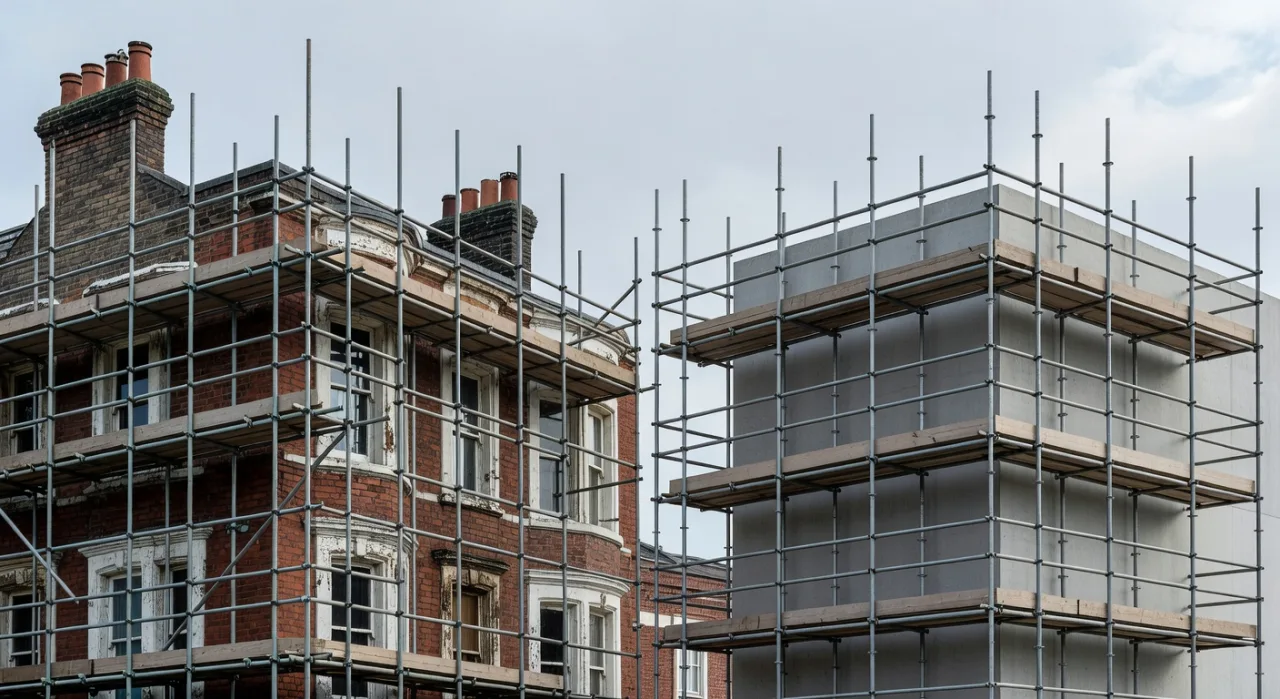
Two fundamentally different approaches to scaffolding dominate the UK market: tube-and-fitting (steel tubes joined with cast-iron couplers) and system scaffolding (pre-engineered modular components like Layher, Cuplok, or Haki). They’re not interchangeable. One is infinitely flexible; the other is faster and more standardised. Choosing between them is a trade-off between adaptability and speed.
This guide covers where each makes sense, the efficiency and cost gap, and why most UK domestic jobs still use tube-and-fitting while most commercial work has moved to system.
How they differ
Tube-and-fitting uses galvanised steel scaffold tubes (Type 4 or Type 3 to BS EN 12811-1) cut to length on site, joined by cast-iron couplers — double couplers for right-angle load-bearing connections, swivel couplers for angled bracing, sleeve couplers for end-to-end joins. Any length, any angle, any configuration.
System scaffolding uses factory-made components with pre-welded connection points. Standards (vertical tubes) have rosettes or cups at fixed 500mm intervals. Ledgers (horizontal tubes) clip or wedge into those connection points. Everything is a fixed length, multiple of a standard module.
The result: tube-and-fitting can be built into any shape. System scaffolds can only be built into shapes that match the module.
Side-by-side comparison
| Tube-and-fitting | System scaffolding | |
|---|---|---|
| Erection speed | Slower — every connection is made by hand | 25–40% faster on standard shapes |
| Adaptability | Unlimited — any angle, any length | Limited to module dimensions |
| Complex shapes (towers, round buildings, varying lifts) | Excellent | Poor to impossible |
| Learning curve | High — requires skilled CISRS operatives | Lower — more predictable builds |
| Component cost | Lower per metre | Higher per metre |
| Labour cost | Higher (longer erection) | Lower (faster erection) |
| Reusability | 10–20 years with inspection | 15–25 years |
| Storage / transport | Dense — tubes stack flat | Bulkier — fixed-shape modules |
| Typical UK use | Domestic, listed buildings, alterations | Commercial, industrial, repetitive builds |
Where tube-and-fitting wins
Domestic work
Almost every domestic scaffold in the UK is tube-and-fitting. A typical house has irregular wall heights, bay windows, eaves overhangs, chimneys, extensions, and neighbours’ boundaries. System scaffolds can’t adapt cleanly to that geometry without multiple transition pieces and bespoke brackets.
Tube-and-fitting also scales down economically. For a scaffold under 50 linear metres with fewer than 3 lifts, the erection-speed advantage of system scaffolding doesn’t outweigh its higher component cost.
Listed buildings and irregular geometry
Old buildings don’t have square corners. Stonework projects, bay windows jut out, chimneys are offset. Tube-and-fitting goes wherever you need it without forcing the building to match a module.
Temporary roofs and heavy-duty bespoke structures
Pedestrian tunnels, free-standing scaffolds with unusual loadings, crash decks over conservatories, scaffolding around sculptures or trees — all tube-and-fitting territory.
Small alterations
Adding a chimney lift to an existing scaffold, extending for an extra trade, adapting for a crane loading bay — much easier on a tube-and-fitting scaffold because you’re just adding more tubes. On a system scaffold, the new section has to match the existing module grid.
Where system scaffolding wins
Large commercial projects
Once you’re past 200 linear metres and 4+ lifts on a repetitive façade, the erection-speed advantage compounds. On a 10-storey commercial refurbishment, system scaffolding can go up 25–40% faster than tube-and-fitting, which translates directly to reduced labour cost and project duration.
High-rise
Above 30m, system scaffolding’s pre-engineered load paths make design sign-off easier. Tube-and-fitting at that height usually requires engineer-specified bracing and tie patterns; a manufacturer’s system scaffold comes with those patterns pre-calculated.
Repetitive builds
Motorway sign gantries, warehouse re-roofs, identical commercial units — system scaffolding wins when you’re building the same shape repeatedly because the speed advantage stacks.
Heavy-loading platforms
System scaffolds designed for heavy-duty class (BS EN 12811-1 Class 4, 300 kg/m²) have pre-certified load capacities — simpler for signoff than calculating a tube-and-fitting alternative.
The myth that one is “better”
Scaffolders sometimes get into debates about which system is superior. They’re both answers to different questions.
- If you’re refurbishing a Grade II-listed Victorian terrace with bay windows and a detached garage, you need tube-and-fitting. System scaffolding physically cannot wrap that shape cleanly.
- If you’re re-roofing a 5,000 m² distribution centre with identical bays every 6 metres, you want system scaffolding. Tube-and-fitting will cost you an extra week and a half in labour.
Most competent scaffolders use both — tube-and-fitting for 85% of domestic jobs, system for commercial repetition, and sometimes a hybrid where a system main scaffold has tube-and-fitting adaptations for corners or features.
Compliance and standards
Both types are governed by the same UK standards and guidance:
- BS EN 12811-1 — performance requirements and general design
- BS 5973 (withdrawn, but referenced) — code of practice for tube-and-coupler
- NASC TG20:21 — industry guidance for tube-and-fitting compliance
- NASC SG4:22 — safe erection and dismantling
For system scaffolding, the manufacturer provides user guides specific to that system (e.g. Layher’s Allround manual) alongside the NASC guidance. A competent scaffolder works to both.
See our separate article on what TG20:21 means and why it matters.
Cost implications
The component purchase price difference is significant:
- Tube-and-fitting tubes: £10–£18 per metre of tube (galvanised, 4mm wall)
- System scaffolding standards: £25–£60 per equivalent metre, including connection rosettes
But component cost isn’t the only factor. System scaffolding’s faster erection reduces labour cost, which on a large job more than offsets the material premium. On small jobs, tube-and-fitting wins on total cost.
Rough breakpoint: under ~150 linear metres and 3 lifts, tube-and-fitting is cheaper to hire. Above that, system scaffolding starts to win.
Hybrid approaches
Many larger jobs use both. A common pattern:
- System scaffolding for the main run of a straight façade
- Tube-and-fitting transitions at corners, around bay windows, over extensions
- Tube-and-fitting bespoke sections for loading bays, chimney access, crash decks
This gets you system scaffolding’s erection speed on the repeating section while keeping the adaptability to handle awkward geometry.
What we use
Stoneley Scaffolding runs tube-and-fitting across all our domestic and most of our commercial work across Hampshire and the South, because the majority of our jobs fall into the domain where tube-and-fitting has the efficiency edge — mixed-geometry houses, listed buildings, extensions, alterations.
For larger commercial jobs where system scaffolding is the better fit, we either hire in manufacturer components to supplement, or partner with specialist system-scaffold firms on a subcontract basis. We’re transparent about when that happens and why.
Every scaffold — tube-and-fitting or system — is:
- TG20:21-compliant (or engineer-designed for configurations outside TG20’s scope)
- Erected to SG4:22
- Built by CISRS-carded crews
- Inspected weekly with signed records
- Covered by £5 million public liability
Frequently asked questions
Is system scaffolding safer than tube-and-fitting?
No, both are safe when properly designed and erected. System scaffolding is sometimes simpler to verify (pre-engineered load paths, fewer connection types), which reduces the scope for human error in complex builds. Tube-and-fitting’s safety depends on the competence of the scaffolders — which is exactly why CISRS carding matters.
Can I mix tube-and-fitting with system scaffolding on one job?
Yes, with proper transition detailing. It’s a common approach on hybrid jobs. The connections between system and tube-and-fitting components need specialist couplers and are usually engineer-signed.
Which is more environmentally friendly?
Both use galvanised steel, both are reusable for 10–25 years, both recycle fully at end of life. System scaffolding’s faster erection reduces fuel-burn for deliveries and generators; tube-and-fitting’s denser stacking reduces transport load. The difference is small either way.
Are Kwikstage, Cuplok, and Layher all “system scaffolding”?
Yes. They’re different proprietary systems — Kwikstage is wedge-based, Cuplok uses rotating cups, Layher uses rosettes — but all three are pre-engineered modular scaffolds falling under the “system” category.
Is tube-and-fitting being phased out?
No, and it won’t be. For adaptable work and irregular geometry, there’s no substitute. The industry has moved system’s way on large commercial jobs, but domestic and refurbishment work remains predominantly tube-and-fitting.
Tube-and-fitting or system scaffolding for your job? If you’re not sure, we’ll tell you straight. Get a quote or call 07925 869 437 and we’ll talk through what’s appropriate.
Need scaffolding in Hampshire or the South?
Get a fixed-price quote within 24 hours. No obligation.